




Estimated reading time: 7 minutes
As organisations continue to implement reforms under the Employment Rights Act 2025, the upcoming changes to the unfair dismissal regime will without doubt have the greatest practical impact on Employers. Although the unfair dismissal regime reforms don’t take effect until January 2027, the practical implications have already begun. Employers need to be adapting their approach to managing probationary periods now.
Unfair Dismissal regime: What changes from 1 January 2027
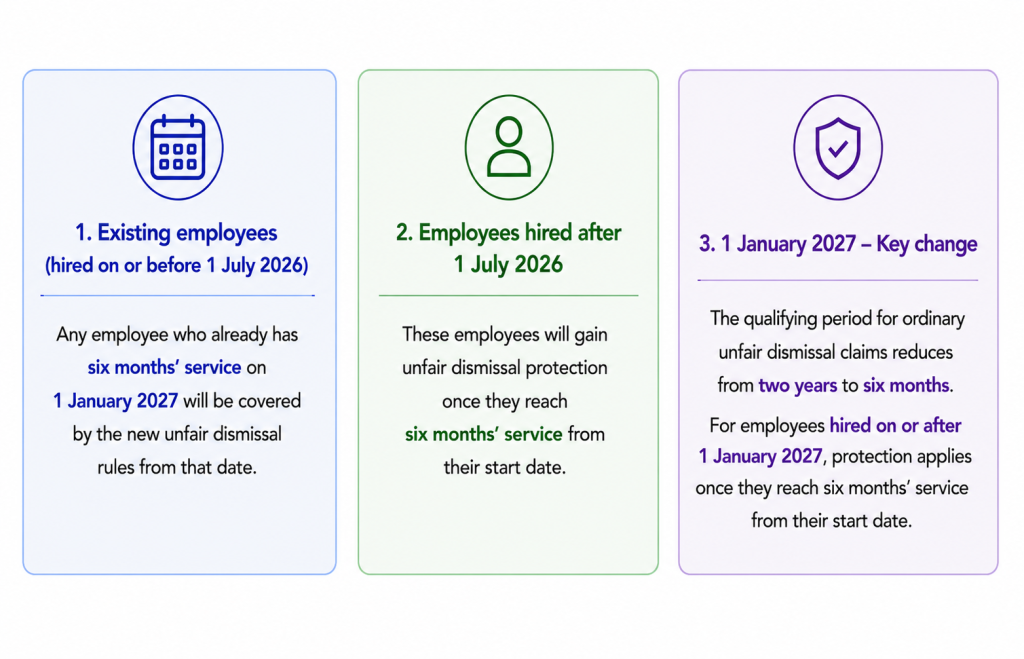
From 1 January 2027, the qualifying period for unfair dismissal protection reduces from two years to six months. The six-month qualifying period applies to employees on fixed-term contracts as well as permanent employees.
For many years, employers have had the relative freedom of a two-year qualifying period in which to assess a new employee before they acquire unfair dismissal rights. From January 2027, employers will have only 6 months in which to identify and address any concerns about an employee’s performance, conduct or overall suitability. The shrinking of the qualifying period to just six months means HRs and line managers will need to manage probationary periods with considerably more precision than they have been used to.
The qualifying period reduction is not the only change to the unfair dismissal regime. The other changes taking effect from 1 January 2027 are:
| Current Position | From 1 January 2027 | |
| Qualifying period for unfair dismissal protection | after 2 years’ service | after 6 months’ service |
| Statutory cap on compensatory award in unfair dismissal claims | £123,543 or 1 year’s pay (lower of) | No cap – full loss of earnings |
| Right to request a written reason for dismissal | after 2 years | after 6 months |
Taken together, the shrinking of the qualifying period for unfair dismissal, and the removal of the statutory cap on compensation awards means many more employees will be able to bring unfair dismissal claims (approximately 6.3 million employees according to the Government’s impact assessment), while the potential cost to employers of getting a dismissal wrong will be considerably higher.
Remember that this six-month qualifying period applies only to ordinary unfair dismissal. Employees continue to have day-one protection against certain automatically unfair dismissals (e.g. for whistleblowing, pregnancy-related reasons or trade union membership or activities) and discrimination.
Employees can also bring breach of contract claims regardless of length of service, for example for failure to give the correct contractual notice or pay salary or contractual benefits due. These existing protections are not changed by the reforms.
The unfair dismissal changes form part of the sweeping changes to employment law coming into force during 2026 and 2027 under the Employment Rights Act 2025. For the full picture, including the steps employers should be taking now to prepare for the changes, see our dedicated article Implementing the Employment Rights Act 2025: A Practical Guide for Employers.
How will the transition to a six-month qualifying period work?
Any employee who already has six months’ continuous service on 1 January 2027 gains unfair dismissal protection immediately on that date.
This means employees hired on or before 1 July 2026 will have unfair dismissal protection from 1 January 2027.
Employees hired after 1 July 2026 will gain protection once they reach six months’ service.
The impact on probationary periods
Most employers operate contractual probationary periods of between three and six months, often with provision to extend them. Under the two-year qualifying period, the probationary period sat comfortably within the employer’s low-risk window. From January 2027, that margin disappears. A six-month probationary period will run directly up against the new qualifying period for unfair dismissal.
The two-year qualifying period has been in place since April 2012 and, in our experience, employers have become accustomed to taking a relaxed approach to managing probationary periods, meaning that new hires who are unsuited to the role have slipped through the net and have to be performance managed at a later date. This takes up costly management time and, if things don’t work out, wastes recruitment costs. This becomes a much bigger problem after 1 January 2027 as once employees have completed six months’ employment, they will have unfair dismissal rights.
In effect, a probationary period longer than 6 months becomes irrelevant under this new regime, because the employee will have unfair dismissal protection after six months.
Managing probationary periods effectively
The new regime requires HR teams and line managers to be on their game and swift when assessing new hires. Update your approach to managing probation periods along these suggested lines:
Set clear standards from the outset, assess performance earlier, review progress regularly with the new hire and deal with problems promptly. If it’s not working out, make dismissal decisions in good time.
- Consider shortening core probationary periods. Employers operating six-month probationary periods should consider moving to a shorter core period of perhaps 3 or 4 months if appropriate to the role.
The aim is to focus minds earlier, giving managers time to assess performance and suitability, address concerns and, where appropriate, extend probation or make a decision before the unfair dismissal qualifying period is reached. - Set clear objectives from the outset. Objectives, competencies and expected standards of performance should be clearly defined and communicated to the employee in writing at the start of the probationary period. Confirm these in writing in the first 5 days of employment.
- Review progress earlier, and formally. Informal check-ins are useful, but should not replace scheduled probation reviews. If possible and appropriate, aim to set monthly formal review meeting dates in the first 3 months. Keep a brief written record of each review, concerns raised, improvements required and agreed actions, something Acas recommends as good practice. Then, if the matter runs towards the six-month threshold, you’re not starting from scratch trying to establish a performance history.
- Deal with problems early. Don’t wait for next month’s formal review if something goes wrong. Address performance or conduct concerns as they arise. This is also consistent with the direction of the revised draft Acas Code of Practice on disciplinary and grievance procedures, which places much greater emphasis on addressing workplace concerns early and informally.
Be clear about what needs to improve and by when and identify any support or training needed to help the employee improve. A problem that is apparent in week 6 but not addressed until month 5 leaves very little time to set expectations for improvement, assess progress and make a decision before unfair dismissal protection kicks in. - Make decisions in good time. Don’t leave the decision whether to confirm, extend or terminate employment until the end of the probationary period. Where there are continuing concerns about an employee’s suitability, managers need to make a decision early enough to allow time to act on it within the six month qualifying period.
Acas published new guidance on probationary periods in July 2026, covering probation reviews, extensions and dismissals. Employers should review their existing probation arrangements against the new guidance.
Don’t assume you have the full six months
This is where we think otherwise careful employers may come unstuck. Statutory notice periods (i.e. one week after a month in the role) count towards the 6-month qualifying service calculation.
If you dismiss an employee without giving the statutory notice to which they are entitled, a week short of them completing six months’ service, that week’s notice may take their qualifying service over the line. The dismissal you thought was within the qualifying period is now beyond it, giving the employee the opportunity to claim unfair dismissal.
In practice, employers may have closer to 5 months and 3 weeks to assess a new hire, upskill or terminate their contract before the right to claim unfair dismissal kicks in. It’s not long, especially if you are taking a chance on a candidate.
It is therefore important for employers to factor in statutory notice when planning to dismiss within the six-month probationary period.
As will have become clear by now, key to all of this is getting recruitment right. Improve your selection processes and learn from any mistakes made.
Effective management of probationary periods will become business critical and a core skill for line managers. Ensure managers are confident to monitor new hires closely and to hold difficult conversations much earlier, well within the six-month qualifying period.
We can help
If you need advice on reviewing your probation arrangements or managing a new hire where things aren’t working out, please get in touch.